
Biometric Attendance Systems: Privacy, Liveness and Workforce Operations
A practical Truefox AI guide to biometric attendance: architecture, implementation, security, evaluation and common questions.
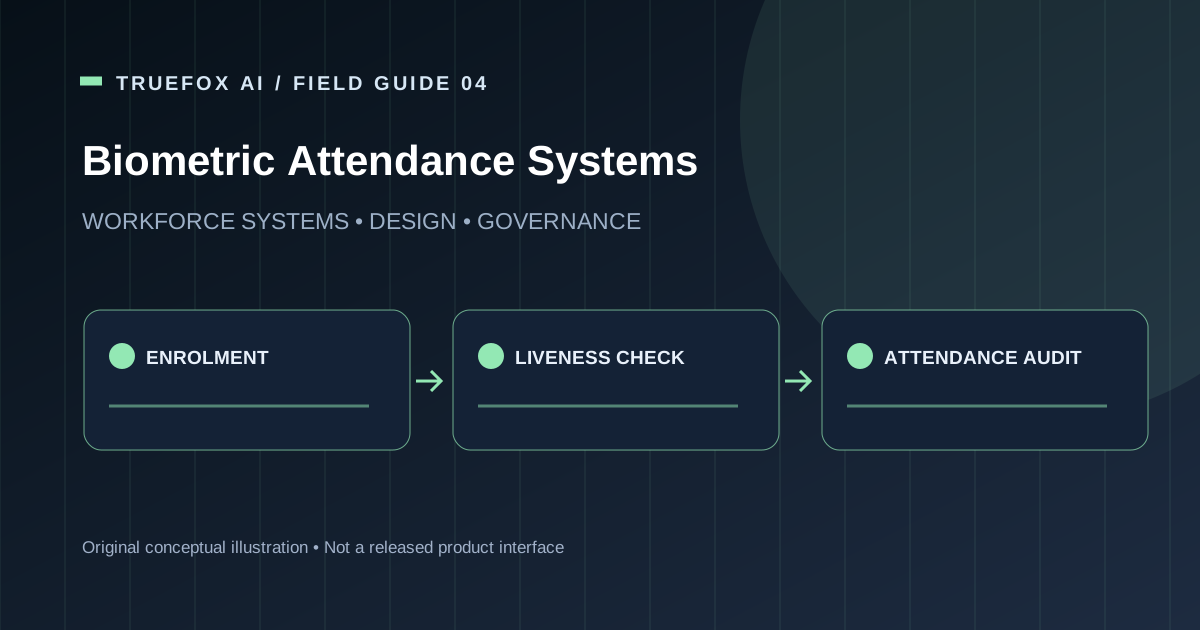
Biometric attendance verifies an enrolled person's identity for attendance events, rather than identifying unknown people in a crowd.
What is biometric attendance?
Biometric attendance verifies an enrolled person's identity for attendance events, rather than identifying unknown people in a crowd. The right architecture depends on data quality, organizational goals, privacy requirements and existing workflows. A product demonstration alone does not establish production readiness.
Where to begin: a practical pilot
Define shifts, error correction, accessible alternatives and supervisor review before linking attendance to payroll. Evaluate whether non-biometric methods suffice. Document success criteria, responsible people and the consequences of inaccurate results before choosing technology. Start with one controlled site or workflow and expand only after independent validation.
Architecture and integration
Design a bounded data flow from input through processing to a reviewed output or operational action. Prefer simple, testable components over unnecessary model complexity. Specify permissions, monitoring, rollback, retention and integration contracts, then evaluate on examples drawn from the actual environment.
How to measure outcomes
Test false accepts, false rejects, liveness robustness, lighting variation and manual exception volume with appropriate fairness review. Compare results against an agreed baseline, record operating costs and track the cases where a person needs to intervene. Report uncertainty and avoid promising universal accuracy or financial returns.
Security, privacy and governance
Biometric templates need minimization, lawful basis, notice, security, strict retention and deletion. Never infer employment misconduct from a single failed match. Document responsible ownership, access review, incidents and ongoing maintenance. Regulatory requirements depend on use case and jurisdiction and should be assessed with qualified advisers.
Example: attendance across rotating shifts
A factory has overlapping shifts and occasionally unreliable connectivity. The attendance workflow must timestamp events accurately, handle offline queuing, detect duplicates and allow managers to correct errors with an audit trail. A worker who fails face verification needs an accessible fallback. Payroll should consume reviewed attendance events, not raw unverified face-match scores.
Face verification versus identification
Verification answers whether a person matches a claimed enrolled identity; identification searches across possible identities. The latter introduces different privacy and risk considerations. Store only the minimum data needed for the chosen flow and avoid using a workforce attendance system for unrelated surveillance or behavioral profiling.
Liveness and device considerations
A camera can be affected by glare, face coverings, motion, device quality and presentation attacks. Evaluate liveness detection against realistic printed images, replay attacks and ordinary environmental failures. Specify acceptable retry limits and manual escalation procedures rather than rejecting legitimate workers without recourse.
Governance and retention
Decide whether biometrics are proportionate and lawful for each location. Document enrolment notices, purpose limitation, retention periods, access policies and deletion on separation. Audit administrator activity and provide privacy-preserving alternatives where required. Obtain specialist legal advice before rollout; a technical demo cannot establish employment-law compliance.
Human review and workplace trust
Design the correction process with employee representatives and managers before rollout. Offer a documented route to dispute attendance records without requiring workers to disclose unnecessary biometric information. Monitor how often a fallback is needed and whether failures vary by device, environment or user group. A fair system should preserve attendance accuracy even when verification is unavailable.
Frequently asked questions
Is face verification required for attendance?
No.
Do liveness checks prevent all spoofing?
No; attacks and environmental failures remain possible.
How Truefox AI can help
Explore our biometric ai engineering and request an initial scope discussion. The proposed Truefox BioTrack direction is discussed here as an illustrative solution concept, not as a claim of a released product, client outcome or guaranteed performance.