
Retail Computer Vision: Footfall, Queues and Shelf Analytics Explained
A practical Truefox AI guide to retail computer vision analytics: architecture, implementation, security, evaluation and common questions.
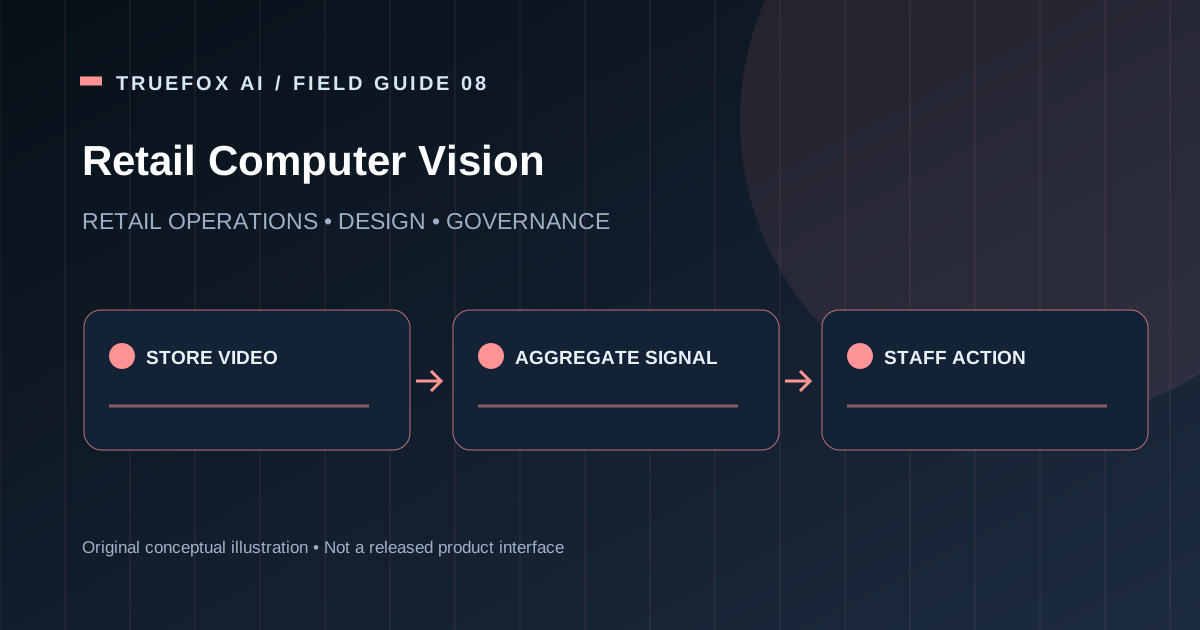
Retail computer vision turns camera observations into operational metrics such as footfall, checkout queues or visible shelf gaps without requiring identity recognition.
What is retail computer vision analytics?
Retail computer vision turns camera observations into operational metrics such as footfall, checkout queues or visible shelf gaps without requiring identity recognition. The right architecture depends on data quality, organizational goals, privacy requirements and existing workflows. A product demonstration alone does not establish production readiness.
Where to begin: a practical pilot
Start with one business decision: when to open a checkout, replenish a shelf or reassign staff. Validate counting rules and camera blind spots. Document success criteria, responsible people and the consequences of inaccurate results before choosing technology. Start with one controlled site or workflow and expand only after independent validation.
Architecture and integration
Design a bounded data flow from input through processing to a reviewed output or operational action. Prefer simple, testable components over unnecessary model complexity. Specify permissions, monitoring, rollback, retention and integration contracts, then evaluate on examples drawn from the actual environment.
How to measure outcomes
Track queue duration, counting error, shelf-check effort, staff response and cost against a store baseline before scaling. Compare results against an agreed baseline, record operating costs and track the cases where a person needs to intervene. Report uncertainty and avoid promising universal accuracy or financial returns.
Security, privacy and governance
Favor aggregate measurements and minimal raw-video retention; review notices, access controls, privacy obligations and limitations on customer tracking. Document responsible ownership, access review, incidents and ongoing maintenance. Regulatory requirements depend on use case and jurisdiction and should be assessed with qualified advisers.
Example: checkout queue monitoring
A supermarket wants to know when additional cashiers are needed. The team can start with anonymous queue-length estimation and a simple alert threshold, then compare estimated waiting time against manual observations. A well-designed pilot tracks whether staff actually respond to alerts and whether queues improve, not just whether objects are detected accurately.
Store-layout and data issues
Counters near entrances can double-count customers who move between zones. Shelf gaps may be hidden by people, reflections or packaging. Define measurement boundaries, camera coverage and success criteria with store managers. Pilot on peak and quiet periods before estimating results across multiple locations.
Privacy-first analytics
Prefer aggregate metrics and short-lived video processing rather than persistent identity tracking. Avoid using facial recognition or inferring sensitive personal characteristics for routine footfall analytics. Apply access controls, notices and appropriate legal review. Track staff or customer identities only where independently justified and authorized.
Business integration and ROI
Connect a reliable metric to a real decision: opening a checkout, triggering a shelf audit or prioritizing replenishment. Evaluate queue time, shelf availability, false alerts and time saved per intervention. Compare with POS and stock-system data when available; video analysis cannot determine inventory records by itself.
Choosing the first store pilot
Select a representative location, document camera visibility and obtain operational sign-off. Sample peak hours, low traffic and temporary aisle changes, then compare algorithmic counts with manual observation. Decide who reviews inaccurate alerts and how staff can report miscounts. Evaluate operational decisions made from the insights rather than treating a video dashboard as a result.
Frequently asked questions
Does footfall counting need facial recognition?
No.
Can video analytics replace inventory systems?
No, it complements POS and stock records.
How Truefox AI can help
Explore our retail ai engineering and request an initial scope discussion. The proposed Truefox RetailAI direction is discussed here as an illustrative solution concept, not as a claim of a released product, client outcome or guaranteed performance.