
Private AI for Enterprises: How to Build a Secure Knowledge Assistant
A practical Truefox AI guide to private AI knowledge assistant: architecture, implementation, security, evaluation and common questions.
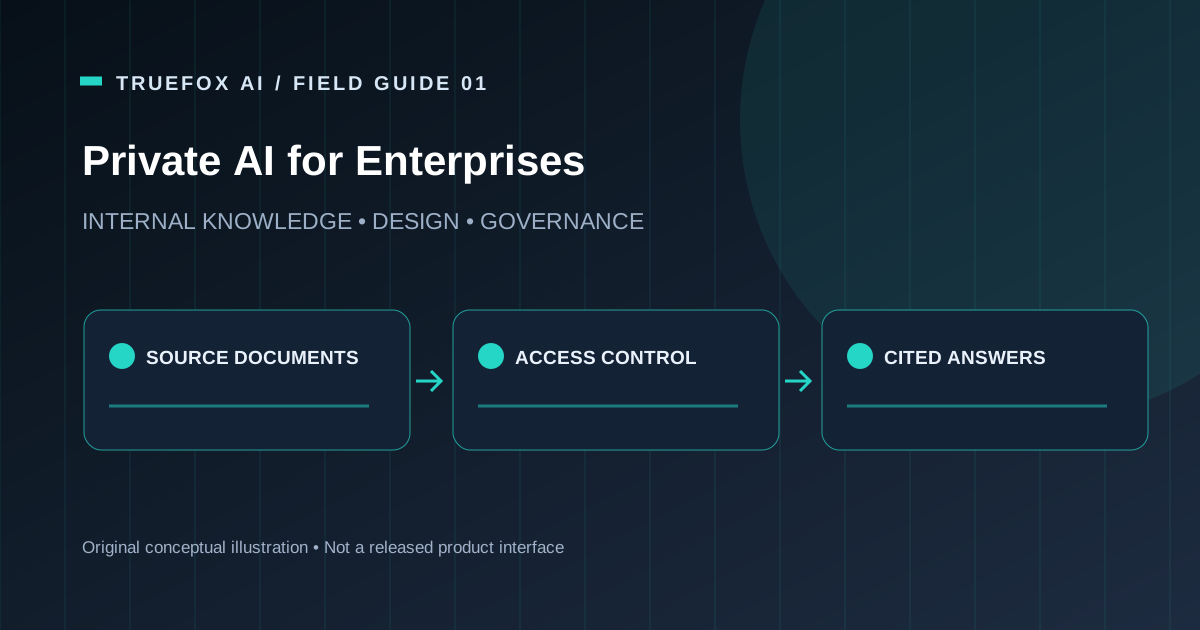
A private AI knowledge assistant answers questions using approved organizational sources, rather than treating a general chatbot as a source of truth.
What is private AI knowledge assistant?
A private AI knowledge assistant answers questions using approved organizational sources, rather than treating a general chatbot as a source of truth. The right architecture depends on data quality, organizational goals, privacy requirements and existing workflows. A product demonstration alone does not establish production readiness.
Where to begin: a practical pilot
Inventory trusted PDFs, policies and databases, enforce document-level permissions before retrieval, then produce answers with citations and explicit uncertainty. Document success criteria, responsible people and the consequences of inaccurate results before choosing technology. Start with one controlled site or workflow and expand only after independent validation.
Architecture and integration
Design a bounded data flow from input through processing to a reviewed output or operational action. Prefer simple, testable components over unnecessary model complexity. Specify permissions, monitoring, rollback, retention and integration contracts, then evaluate on examples drawn from the actual environment.
How to measure outcomes
Evaluate groundedness, permission leakage, stale documents, abstentions, latency and cost using representative employee questions. Compare results against an agreed baseline, record operating costs and track the cases where a person needs to intervene. Report uncertainty and avoid promising universal accuracy or financial returns.
Security, privacy and governance
Private deployment does not automatically guarantee security: encryption, identity, retention, logging and prompt-injection defenses remain necessary. Document responsible ownership, access review, incidents and ongoing maintenance. Regulatory requirements depend on use case and jurisdiction and should be assessed with qualified advisers.
Example: an internal policy assistant
A staff member asks, "Which procurement policy applies to a supplier renewal?" A credible assistant first verifies the person's permissions, retrieves the latest approved policy and related exceptions, then cites the passages used in its answer. If documents disagree or do not cover the case, it should say so and direct the person to the policy owner. A generic answer based on broad model knowledge is not a substitute for an organization's approved guidance.
Implementation decisions for architects
Determine whether document access is managed by existing identity groups, source-system ACLs or a dedicated permission layer. Build ingestion pipelines that retain source IDs, page references, revision timestamps and deletion events. Apply authorization at query and retrieval time, not only when creating the index. Decide whether embeddings and prompts may leave your environment, and evaluate model endpoints against your data handling agreements.
Failure modes to test
Try questions about revoked documents, cross-team restricted files, ambiguous policy names and information that does not exist. Seed test documents with hostile instructions to assess prompt-injection resistance. Test whether users can infer confidential data from citations, autocomplete or logs. Record how the system explains missing information; a correct refusal is sometimes the desired result.
Procurement questions
Ask vendors for deployment boundaries, incident response commitments, audit-log access, data deletion behavior and evidence of permission enforcement. Compare hosting and support costs rather than assuming self-hosting is automatically cheaper. A pilot should produce an acceptance report, ownership model and rollback plan before broader release.
Frequently asked questions
Is RAG the same as training a new model?
No. RAG retrieves relevant content at answer time.
Can this run on premises?
Yes, if hardware, model licensing and operational capacity permit.
How Truefox AI can help
Explore our private ai engineering and request an initial scope discussion. The proposed Truefox Private AI direction is discussed here as an illustrative solution concept, not as a claim of a released product, client outcome or guaranteed performance.