
Industrial IoT and Edge AI: Building Reliable Sensor Monitoring
A practical Truefox AI guide to industrial IoT edge monitoring: architecture, implementation, security, evaluation and common questions.
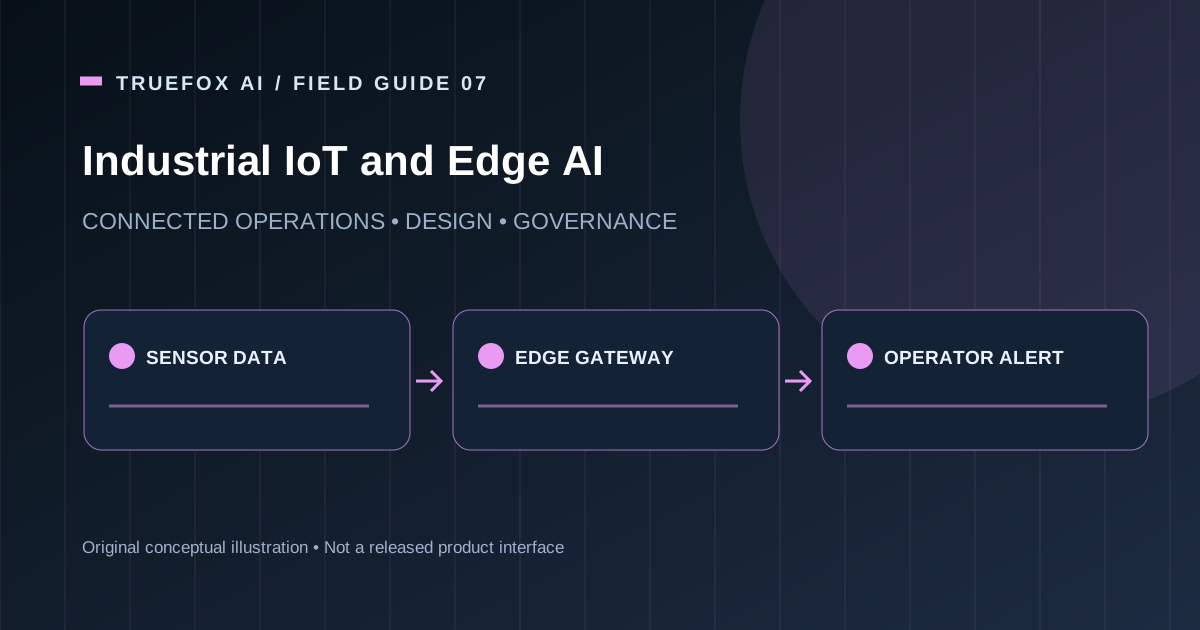
Industrial IoT combines authenticated sensors, gateways and monitoring workflows; edge AI can add local anomaly analysis when bandwidth or latency requires it.
What is industrial IoT edge monitoring?
Industrial IoT combines authenticated sensors, gateways and monitoring workflows; edge AI can add local anomaly analysis when bandwidth or latency requires it. The right architecture depends on data quality, organizational goals, privacy requirements and existing workflows. A product demonstration alone does not establish production readiness.
Where to begin: a practical pilot
Define signals such as temperature, vibration, humidity and equipment status, including calibration, sampling and a named response for every alert. Document success criteria, responsible people and the consequences of inaccurate results before choosing technology. Start with one controlled site or workflow and expand only after independent validation.
Architecture and integration
Design a bounded data flow from input through processing to a reviewed output or operational action. Prefer simple, testable components over unnecessary model complexity. Specify permissions, monitoring, rollback, retention and integration contracts, then evaluate on examples drawn from the actual environment.
How to measure outcomes
Plan encrypted transport, device identity, network segmentation, offline buffering, firmware updates and safe recovery after communications failure. Compare results against an agreed baseline, record operating costs and track the cases where a person needs to intervene. Report uncertainty and avoid promising universal accuracy or financial returns.
Security, privacy and governance
Validate alert usefulness, false alarms, downtime and maintenance outcomes before describing anomaly monitoring as predictive maintenance. Document responsible ownership, access review, incidents and ongoing maintenance. Regulatory requirements depend on use case and jurisdiction and should be assessed with qualified advisers.
Example: temperature monitoring in a warehouse
A cold-storage operator needs alerts when monitored zones drift outside documented thresholds. The first design task is defining calibrated sensors, measurement intervals, acceptable ranges and an operator response. An anomaly score can support analysis, but a clear threshold and accountable alert workflow may be the safest initial solution.
Connectivity and device architecture
Specify device identities, message authentication, encrypted telemetry and firmware-update strategy. Plan for power loss, delayed messages and local buffering when internet access fails. Device clocks need synchronization so reports do not confuse measurement time with ingestion time. Segregate operational networks from general office systems where appropriate.
Analytics without premature predictions
Start with trend visualization and rule-based alerts, then add anomaly detection when representative operational data exists. Predictive maintenance needs historical failures, maintenance events and a measurable intervention window. Report uncertainties, false alarms and missed anomalies; distinguish exploratory signals from validated failure forecasts.
Operations and lifecycle management
Budget for sensor calibration, hardware replacements, connectivity, support and cybersecurity patching. Measure delivery reliability, alert response time and prevented incidents against baseline procedures. Site-specific environmental conditions matter; a model trained on one machine may not transfer reliably to another.
Planning a staged deployment
Pilot one site or machine family with a documented operator feedback loop. Keep sensor installation maps, maintenance schedules, calibration dates and alert thresholds under change control. Test simulated network outages and delayed data before expanding to additional locations. Separate dashboards intended for situational awareness from automated control systems requiring formal safety engineering.
Frequently asked questions
Must every edge device have a GPU?
No.
Can data stay onsite?
Yes, subject to operations and remote-support needs.
How Truefox AI can help
Explore our edge ai engineering and request an initial scope discussion. The proposed Truefox Edge direction is discussed here as an illustrative solution concept, not as a claim of a released product, client outcome or guaranteed performance.