
Enterprise AI Agents: A Practical Guide to Governed Workflow Automation
A practical Truefox AI guide to enterprise AI agents: architecture, implementation, security, evaluation and common questions.
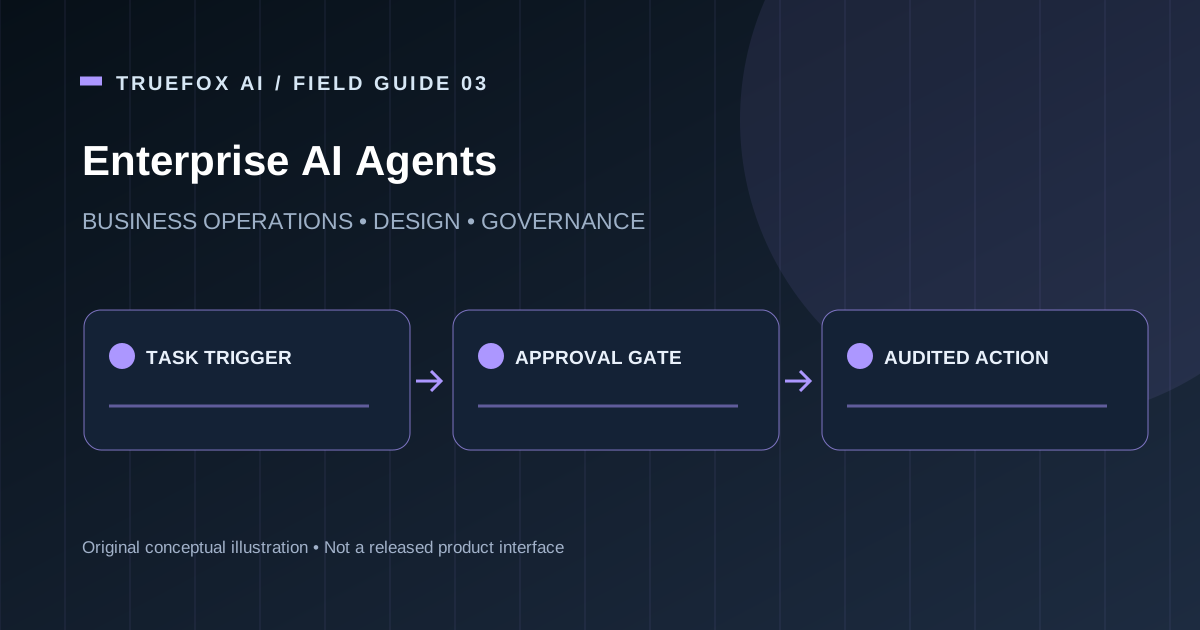
Enterprise AI agents orchestrate tool-assisted steps in business processes with defined permissions, approval rules and exception handling.
What is enterprise AI agents?
Enterprise AI agents orchestrate tool-assisted steps in business processes with defined permissions, approval rules and exception handling. The right architecture depends on data quality, organizational goals, privacy requirements and existing workflows. A product demonstration alone does not establish production readiness.
Where to begin: a practical pilot
Begin with a read-only or draft-only workflow such as email triage or CRM note preparation. Map tool access and human ownership before allowing write actions. Document success criteria, responsible people and the consequences of inaccurate results before choosing technology. Start with one controlled site or workflow and expand only after independent validation.
Architecture and integration
Design a bounded data flow from input through processing to a reviewed output or operational action. Prefer simple, testable components over unnecessary model complexity. Specify permissions, monitoring, rollback, retention and integration contracts, then evaluate on examples drawn from the actual environment.
How to measure outcomes
Test tool failures, ambiguous instructions, prompt injection, authorization bypass and duplicate actions; measure completion and human correction rates. Compare results against an agreed baseline, record operating costs and track the cases where a person needs to intervene. Report uncertainty and avoid promising universal accuracy or financial returns.
Security, privacy and governance
Use least-privilege service credentials, tenant isolation, audit trails and mandatory approval before external emails, payments or irreversible changes. Document responsible ownership, access review, incidents and ongoing maintenance. Regulatory requirements depend on use case and jurisdiction and should be assessed with qualified advisers.
Example: sales email drafting with human approval
A customer sends a requirements email. The agent may classify the request, retrieve approved service information, prepare a CRM note and draft a response. Before sending the response or modifying a price, a responsible employee reviews the draft. This separation between preparation and execution limits the consequences of mistaken reasoning or prompt injection in inbound messages.
Orchestration design
Use explicit states for received, classified, drafted, awaiting approval, delivered and failed. Make actions idempotent so retries do not duplicate emails or CRM entries. Scope each connector to the minimum required read or write permissions. Store workflow IDs and human approvals, and design timeouts and compensating steps for partial failures.
Prompt injection and tool security
Treat messages, attachments, retrieved webpages and tool outputs as untrusted material. They may contain instructions that attempt to redirect the agent. Enforce allowed recipients, monetary limits, tenant boundaries and action permissions in ordinary backend code, not only in a prompt. Keep tokens and connector secrets out of model context where possible.
Evaluation and rollout
Build a representative task set covering normal enquiries, missing fields, adversarial content and unavailable integrations. Measure completion with human corrections and the percentage of actions escalated. Introduce approved write operations only after read-only and draft-only modes work reliably. Compare business value with simpler scripts and workflow engines before adopting agents.
Frequently asked questions
Does every automation need an agent?
No. Deterministic rules are often preferable.
Can an agent act autonomously?
Only within approved and carefully tested boundaries.
How Truefox AI can help
Explore our agentic automation engineering and request an initial scope discussion. The proposed Truefox AgentOS direction is discussed here as an illustrative solution concept, not as a claim of a released product, client outcome or guaranteed performance.