
AI Visual Quality Inspection: From Defect Dataset to Factory Pilot
A practical Truefox AI guide to AI quality inspection: architecture, implementation, security, evaluation and common questions.
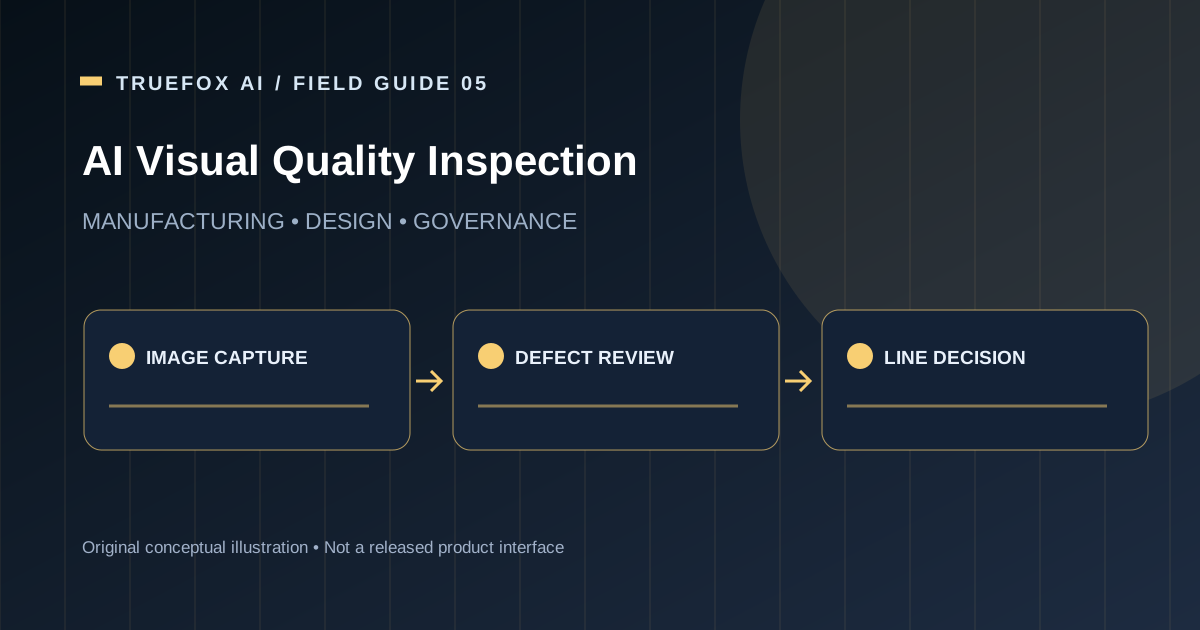
AI visual inspection uses camera images and machine learning to help detect product, packaging or surface defects during manufacturing.
What is AI quality inspection?
AI visual inspection uses camera images and machine learning to help detect product, packaging or surface defects during manufacturing. The right architecture depends on data quality, organizational goals, privacy requirements and existing workflows. A product demonstration alone does not establish production readiness.
Where to begin: a practical pilot
Define defect classes with plant experts, capture varied batches and lighting conditions, and reserve independent test images. Camera optics and illumination often matter as much as models. Document success criteria, responsible people and the consequences of inaccurate results before choosing technology. Start with one controlled site or workflow and expand only after independent validation.
Architecture and integration
Design a bounded data flow from input through processing to a reviewed output or operational action. Prefer simple, testable components over unnecessary model complexity. Specify permissions, monitoring, rollback, retention and integration contracts, then evaluate on examples drawn from the actual environment.
How to measure outcomes
Run shadow mode before automatic rejection. Track defect recall, false-reject rate, inspection latency, throughput and operator overrides. Compare results against an agreed baseline, record operating costs and track the cases where a person needs to intervene. Report uncertainty and avoid promising universal accuracy or financial returns.
Security, privacy and governance
Integrate with manufacturing systems through controlled interfaces. Design safe behavior for network loss, model uncertainty and camera calibration drift. Document responsible ownership, access review, incidents and ongoing maintenance. Regulatory requirements depend on use case and jurisdiction and should be assessed with qualified advisers.
Example: packaging seal defects
A packaging line experiences occasional incomplete seals. Engineers should first define measurable categories with quality-control staff and record how each defect affects downstream safety or rework. Then capture approved samples across production shifts, batches and camera settings. Train-test leakage can make results look better than they are if adjacent frames from the same item appear in both sets.
Camera and dataset architecture
Use consistent lighting, lens selection, focus and exposure and record capture parameters. Inspect dataset balance across defect severity and accepted variations. Maintain an annotation protocol, versioned labels and an independent evaluation set that reflects future production. Where defect examples are rare, anomaly detection can be investigated but still requires validation.
Integrating with the production line
Separate detection from the actuator that rejects or diverts products. Define how uncertain predictions are handled, how operators can override decisions and what happens if the AI service fails. Integrate with quality management or manufacturing execution systems through audited interfaces; do not assume a model score alone justifies automated rejection.
Economics and maintenance
Estimate false rejects, missed defects, reduced manual inspection, hardware depreciation and downtime from retraining or camera maintenance. Run shadow-mode comparisons before switching on automated actions. Re-evaluate after material changes, product redesigns, lighting adjustments or model upgrades; sustained performance requires ongoing ownership.
Frequently asked questions
Can anomaly detection work without labeled defects?
It may, but needs representative normal samples and validation.
Is demo accuracy factory accuracy?
No.
How Truefox AI can help
Explore our manufacturing ai engineering and request an initial scope discussion. The proposed Truefox Inspect direction is discussed here as an illustrative solution concept, not as a claim of a released product, client outcome or guaranteed performance.