
AI CCTV Security: Designing Real-Time Video Analytics for Safer Sites
A practical Truefox AI guide to AI video analytics: architecture, implementation, security, evaluation and common questions.
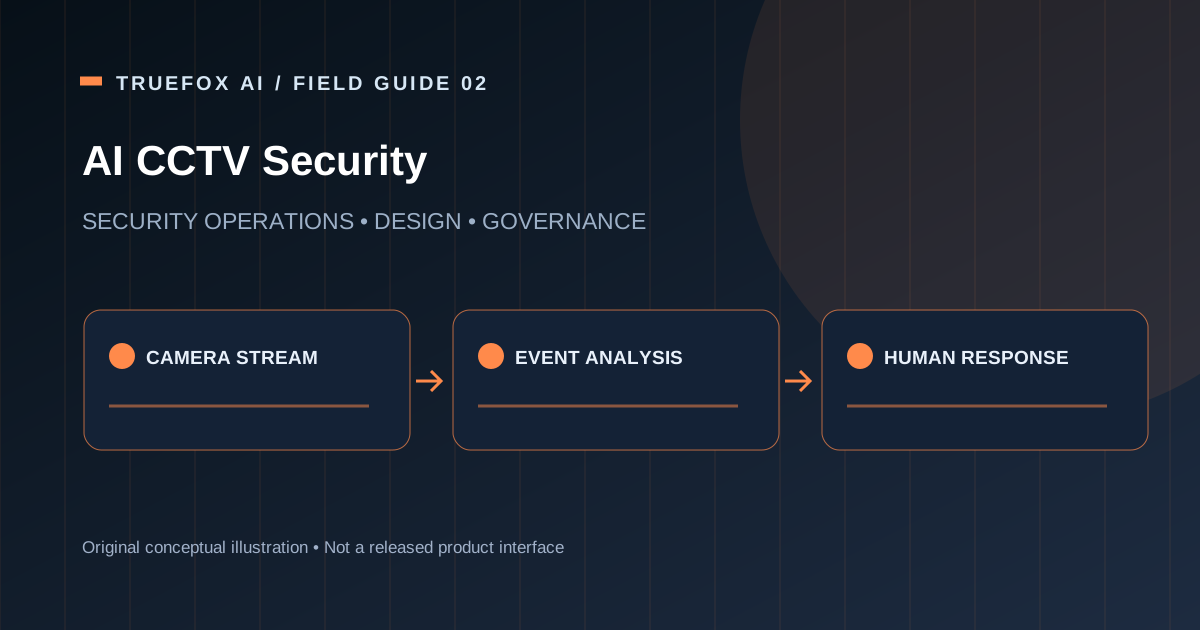
AI CCTV analytics detects predefined events in existing camera streams; it does not replace security professionals or certified life-safety equipment.
What is AI video analytics?
AI CCTV analytics detects predefined events in existing camera streams; it does not replace security professionals or certified life-safety equipment. The right architecture depends on data quality, organizational goals, privacy requirements and existing workflows. A product demonstration alone does not establish production readiness.
Where to begin: a practical pilot
Choose one measurable scenario such as restricted-zone crossing or after-hours intrusion. Validate camera positioning, lighting, occlusion and alert handoff. Document success criteria, responsible people and the consequences of inaccurate results before choosing technology. Start with one controlled site or workflow and expand only after independent validation.
Architecture and integration
Design a bounded data flow from input through processing to a reviewed output or operational action. Prefer simple, testable components over unnecessary model complexity. Specify permissions, monitoring, rollback, retention and integration contracts, then evaluate on examples drawn from the actual environment.
How to measure outcomes
Compare missed incidents, false alerts, response latency and operator workload under actual site conditions. Compare results against an agreed baseline, record operating costs and track the cases where a person needs to intervene. Report uncertainty and avoid promising universal accuracy or financial returns.
Security, privacy and governance
Prefer limited metadata over continuous cloud video where possible. Apply retention limits, access controls and privacy reviews; biometric recognition is a separate use case. Document responsible ownership, access review, incidents and ongoing maintenance. Regulatory requirements depend on use case and jurisdiction and should be assessed with qualified advisers.
Example: restricted-zone monitoring at a warehouse
A warehouse operator wants a notification when someone enters a marked loading area after hours. The first step is not a facial-recognition model: it is defining the camera field of view, a virtual zone, operating hours, alert severity and who verifies the event. The system should preserve enough evidence for authorized review without indiscriminately retaining every stream.
Camera and network design decisions
Determine whether existing cameras supply reliable RTSP or ONVIF streams, adequate illumination, a stable frame rate and synchronized timestamps. Check bandwidth, edge compute power, failover, stream authentication and safe storage of recording credentials. A site with backlighting or heavy rain may need camera repositioning before software changes make sense.
Responsible alert handling
Distinguish human detection, vehicle detection and zone crossing from identity recognition. Escalate uncertain events for operator review and document how staff respond to false alarms. If an alert concerns smoke or visible hazards, use it as supplementary situational awareness, not as a replacement for certified fire detection or emergency protocols.
Pilot acceptance criteria
Record event recall and precision on both daytime and nighttime footage, time-to-alert, events missed because of occlusion and the burden on security staff. Validate with authorized operational samples, not selected promotional clips. Define who can view incidents, how long videos remain available and what happens when the internet or AI service is offline.
Frequently asked questions
Can existing IP cameras be used?
Often, if streams and site permissions are compatible.
Does smoke detection replace a fire alarm?
No, it is supplementary.
How Truefox AI can help
Explore our computer vision engineering and request an initial scope discussion. The proposed Truefox Vision direction is discussed here as an illustrative solution concept, not as a claim of a released product, client outcome or guaranteed performance.